
Review construction BOQ and specifications together with the drawings before requesting prices or agreeing a contract. Check that item descriptions, quantities and technical requirements describe the same work. Record unclear inclusions, conflicting revisions and unfinished decisions, then obtain a coordinated written response from the responsible advisers.
For Pakistan building owners, this review is about understanding what the project documents establish and what remains uncertain. A detailed spreadsheet can still contain gaps. A long specification may describe products that the drawings never locate. This guide provides a review matrix and two practical examples: a floor-finish item and an HVAC equipment item.
The bill of quantities, or BOQ, organises described work into items with units and quantities for pricing. Its preambles and measurement rules help explain what those items include. Specifications describe technical requirements such as materials, performance, workmanship and acceptance. Drawings show the arrangement, locations, dimensions and construction details.
Contract conditions establish the commercial and administrative framework, including how discrepancies, measurements and changes are handled. The precise relationship depends on the documents incorporated into your contract. Do not assume that one document automatically overrides every other document.
PEC’s December 2023 construction bidding document illustrates the relationship: its BOQ preamble directs readers to consider the contract conditions, specifications and drawings together. Its specific pricing and measurement provisions belong to that document form; they are not a universal rule for every private project.
Ask the appointed quantity surveyor, engineer or contract adviser to explain the pricing basis. A bill of quantities in Pakistan may sit within different contract arrangements. Confirm whether quantities are subject to measurement and how the agreed contract treats missing or changed work.
Create a common document register before reviewing individual items. Identify the BOQ issue, specification revision, drawing numbers and approved addenda. Confirm which documents the pricing parties will receive and whether every referenced schedule is actually included.
A drawing updated after quantities were prepared can introduce a discrepancy even when both documents appear complete. Check altered room layouts, equipment counts and finish selections against affected items. Record the discrepancy instead of quietly replacing a quantity yourself.
Use a BOQ review checklist that follows the same references throughout. The matrix below is a suggested owner review tool, not a prescribed national form. Populate it with actual project references and retain the original issue history.
| BOQ Item | Drawing Reference | Specification Reference | Question to Resolve |
|---|---|---|---|
| Floor finish | Finish plan and build-up detail | Flooring clause and schedule | Is substrate preparation included? |
| Air-conditioning unit | HVAC layout and equipment schedule | Equipment and installation clauses | Who provides each connection? |
| External drainage | Drainage layout and sections | Pipework and testing clauses | Where does the priced scope end? |
| Site facilities | Site logistics plan where provided | General requirements | Which facilities and duration are priced? |
Give construction BOQ and specifications a review status, such as draft for comment or issued for pricing. Record remaining design assumptions explicitly. A package issued early for budgeting should identify its limits so the resulting prices are not mistaken for an offer based on completed design.
Read BOQ item descriptions for the actual work being purchased. Identify the location, material or system reference and whether the item covers supply, installation or a complete defined activity. Wording such as “standard”, “complete” or “as necessary” needs supporting references to establish what bidders should include.
Confirm that the unit suits the described work and that abbreviations are defined consistently. Area, length, volume, weight, number and lump-sum items require different checks. Ask the quantity surveyor which measurement rules apply, including treatment of openings, overlaps, accessories and waste.
Do not automatically add a waste percentage to every quantity. The measurement basis, item wording and pricing instructions determine how waste and related costs are addressed. Likewise, confirm what a lump-sum item covers instead of treating the label as proof that no further definition is needed.
Request traceable quantity calculations for material items or areas that could significantly affect the budget. Compare sample locations with current drawings and schedules. The owner can identify questions without attempting to certify the complete quantity take-off.
Check repeated floors, omitted rooms and items that appear in several packages. Review quantity extensions and summary transfers in priced documents. An arithmetic correction and a technical scope change are different issues; record them separately and use the agreed process to resolve each.
A construction specification review should establish how the completed work will be assessed. Check the required material characteristics, system performance, installation requirements and relevant standards. Identify samples, mock-ups, inspections and tests where required, together with the responsible reviewer.
A product name alone may leave size, finish, grade, accessories or intended duty unclear. If alternatives are permitted, ask how equivalence will be demonstrated and who approves it. The owner should understand the decision process without selecting technical substitutions independently.
Review maintenance and handover requirements alongside installation. Equipment identification, access, operating information and testing can affect what the contractor must price. Podium’s design and engineering services describe multidisciplinary coordination; confirm the actual document-review duties within the project appointment.
Ask whether the specification matches the intended use and available site conditions. Refer contradictions to the appropriate designer. Do not resolve technical gaps by accepting the cheapest available material or inserting a performance figure without engineering review.
List provisional sums in construction separately from fully defined measured work. Ask what uncertainty each sum represents, who may instruct its use and how the expenditure will be valued under the contract. An allowance is not evidence that the underlying scope has been designed or fully priced.
Check construction scope omissions across package boundaries: excavation and disposal, builder’s work for services, temporary facilities, testing, reinstatement and final cleaning where relevant. Also identify equipment supplied directly by the owner and the contractor’s associated handling or installation responsibilities.
Review general requirements and preliminaries for site establishment, supervision, protection, access and the intended programme. PEC’s sample general-items bill includes project-wide items and expressly labels its descriptions as examples. Use the actual project requirements to decide which items belong in your package.
Make drawings and BOQ coordination a joint task for the relevant disciplines. For example, a mechanical equipment item and an electrical feeder item may both be correct while the control connection remains unassigned. Record the interface and its owner rather than duplicating the whole installation in both bills.

Imagine an office BOQ stating “floor tiles, 240 square metres”. This is a hypothetical teaching example, not a quantity estimate or a recommended specification. The finish schedule identifies a porcelain tile, but the owner cannot find a coordinated build-up detail.
| What Is Unclear | Evidence to Check | Clarification Needed |
|---|---|---|
| Tile selection | Approved finish schedule | Confirm product characteristics and finish |
| Underlying layers | Floor build-up detail and specification | Define preparation and layer responsibilities |
| Skirtings and transitions | Details and related BOQ items | Identify inclusion or separate pricing |
| Area quantity | Current plan and measurement basis | Confirm the take-off and exclusions |
The owner asks the architect to confirm the finish system and the quantity surveyor to reconcile the description and measurement. The response identifies where substrate preparation, adhesive, grout, skirtings and transitions are priced, including any separate items. It also resolves interfaces with adjoining floor finishes.
Review construction BOQ and specifications again after that response. Close the query only when the drawing, specification and pricing references agree. A verbal assurance that “everything is included” leaves the original ambiguity unresolved and gives future reviewers no reliable reference.
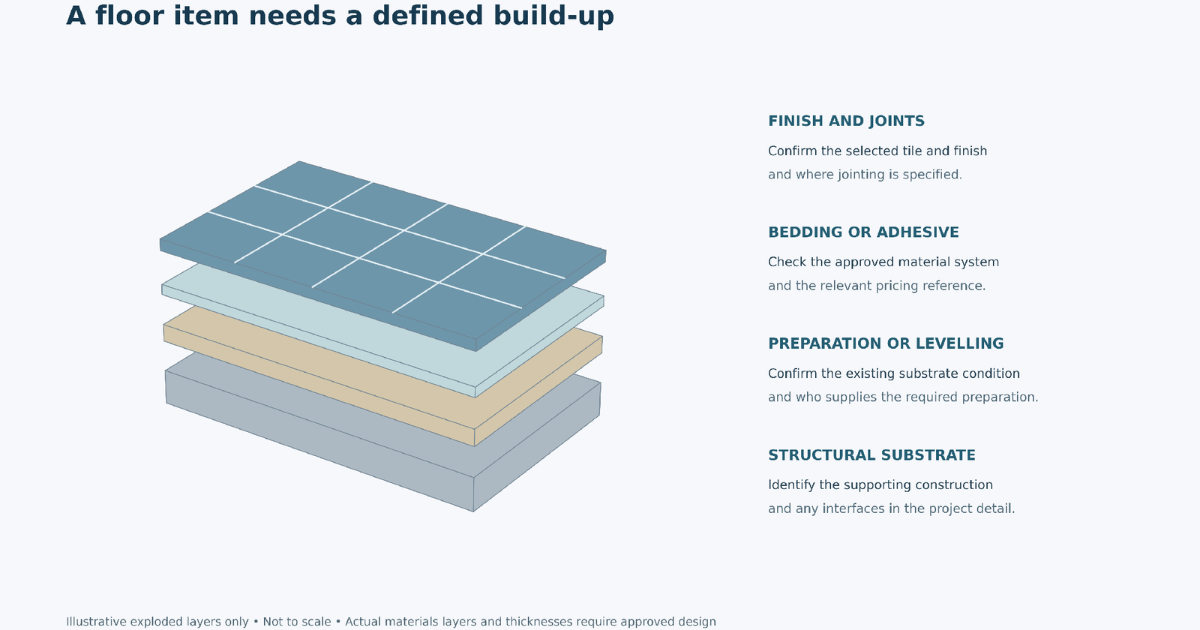
A practical question is: “Which item covers making the existing floor ready for the selected finish?” Ask for a reference and an agreed responsibility. If the substrate condition is unknown, record the investigation or assumption needed instead of hiding that uncertainty inside the tile area.
Consider another hypothetical entry: “supply and install one air-conditioning unit”. The equipment schedule identifies the selected unit, but the documents do not clearly assign power, controls and condensate connections. The owner should not infer that every associated activity belongs to this line.
| Interface | Documents to Compare | Required Resolution |
|---|---|---|
| Power supply | Electrical layout and electrical BOQ | Identify the priced feeder and connection |
| Controls | Controls schedule and system specification | Assign devices wiring and integration |
| Condensate drainage | Mechanical layout and plumbing items | Confirm route connection and responsibility |
| Supports and testing | Installation details and test requirements | Identify scope evidence and accepting reviewer |
The MEP designer coordinates the interfaces and the quantity surveyor checks the corresponding items. Podium’s MEP services describe related engineering disciplines; the project team must still identify specific responsibilities and deliverables. No capacity, cable size or drainage design should be guessed from the short item description.
The useful outcome is a documented allocation: included in this item, priced under another reference, owner-supplied or still unresolved. This prevents the owner from treating an equipment price as the complete system cost while also helping expose duplicated allowances.
Keep a clarification register with the issue, affected references, responsible reviewer, response and revised issue date. Obtain a coordinated answer when several disciplines are involved. Share the authorised document changes consistently with pricing parties through the applicable enquiry or procurement process.
| Issue | Responsible Reviewer | Response and Final Reference |
|---|---|---|
| Floor preparation inclusion | Architect and quantity surveyor | Record agreed scope and revised item |
| HVAC controls allocation | MEP designer and quantity surveyor | Record package owner and document revision |
Before relying on construction BOQ and specifications, ask the project advisers to confirm the unresolved items and their budget implications. Keep uncertain amounts visible. Do not interpret a blank rate, missing item or conflicting document as a commercial entitlement without reviewing the relevant contract provisions.
For finish interfaces, Podium’s fit-out works page provides related scope context. Discuss your drawings, specification package and construction requirements through Podium’s construction services, confirming the appropriate Pakistan contact route and project availability. A clearly defined review appointment should identify who checks technical requirements, quantities and contractual wording.
Find quick answers about our manufacturing processes, project timelines, and service capabilities.
No universal priority rule applies to every project. Check the agreed contract documents and discrepancy procedure. Ask the contract administrator to resolve conflicts formally, with input from the designer and quantity surveyor where needed.
Not automatically. Scope and payment treatment depend on the contract, preambles and related documents. Record the omission and obtain a coordinated written response. Avoid assuming either free inclusion or an automatic additional payment entitlement.
No. The contract establishes whether quantities are fixed, provisional or subject to measurement and how changes are valued. Ask your quantity surveyor to explain the applicable basis before using the total as a firm commitment.
A brand reference may not establish every required characteristic, accessory or installation condition. Review the model, performance, finish and relevant technical clauses. Confirm the approval process for alternatives rather than assuming all products are interchangeable.
Assign technical requirements to the relevant designer and measurement questions to the appointed quantity surveyor. The contract administrator should address contractual interpretation through the agreed procedure. Coordinate their responses where a query affects several documents.