
Use a commercial fit-out handover checklist to confirm what your business is accepting, how the space performs and what remains unfinished. Inspect the agreed scope, review test evidence, receive usable operating information and assign every outstanding item. Record the acceptance decision through the procedure established for your project.
A finished reception and new furniture can make an office look ready while its controls, maintenance records or defect responsibilities remain unclear. For Pakistan businesses, a useful handover connects the physical space to the people who will operate it. This guide helps owners, procurement teams and facilities managers organise that evidence without treating key collection as the whole process.
Start with the signed scope, approved drawings, specifications and recorded changes. Establish which areas and systems belong to the fit-out contractor, landlord, business owner or separate suppliers. An office inside a multi-tenant building may depend on base-building services that sit outside the fit-out appointment.
For fit-out handover in Pakistan, identify the contract’s acceptance process and authorised representatives before arranging the walkthrough. Clarify whether the proposed handover covers the entire premises or a defined phase. Record areas that remain under construction and how they will be separated from occupied operations.
Confirm who can accept architectural finishes, review engineering evidence and receive operational responsibilities. Keep required landlord permissions and authority documents identifiable. A contractor’s completion statement, the client’s contractual acceptance and permission to occupy or operate serve different purposes.
Arrange the inspection with people who can make decisions, supported by the current document register. Agree how comments will be recorded and how the contractor will respond. This avoids several disconnected snag lists with conflicting instructions.
Use an office fit-out snagging checklist organised by room, zone or grid reference. Check completed work against approved requirements and agreed samples. Photographs should show both the defect and enough surrounding context to identify its location later.
Review floors, walls and ceilings for incomplete work, damage and inconsistent finishing. Inspect junctions, sealant, skirtings and access panels. Look at surfaces under the intended lighting conditions rather than judging them only while temporary work lights are operating.
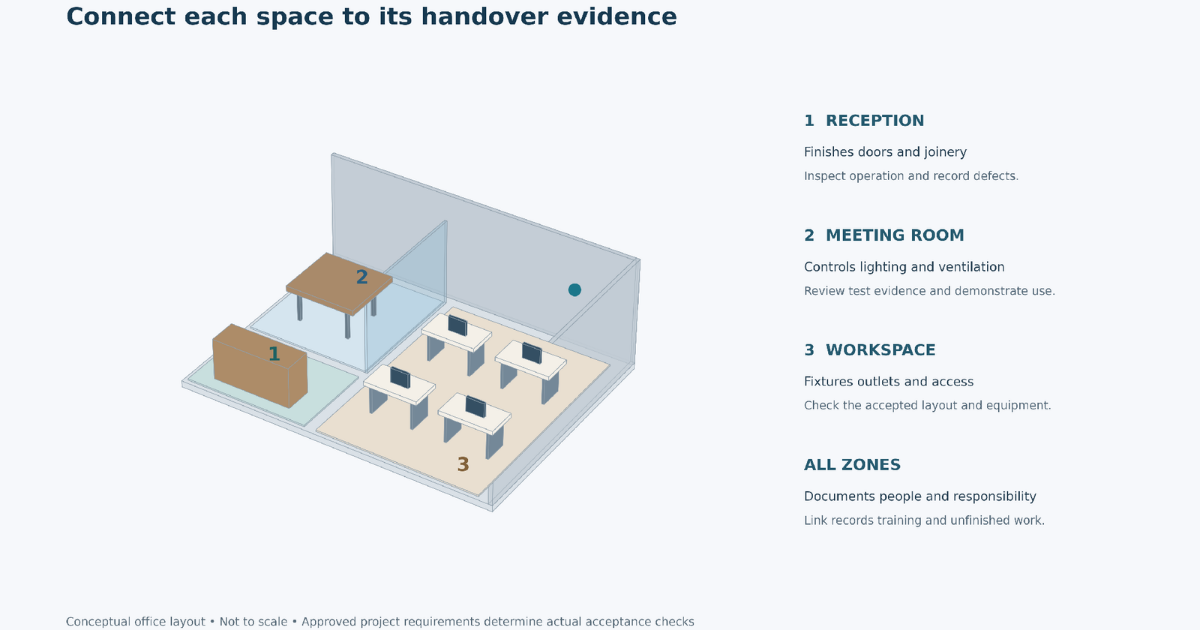
Operate doors, drawers and cupboard hardware. Check alignment, locking, approved finishes and the practical use of counters and storage. Confirm that installed fixtures match the agreed schedule and that loose or unfinished items are recorded for correction.
Walk through normal business activities: entering reception, using a meeting room, reaching outlets and accessing staff facilities. Check the approved accessibility and circulation arrangements with the responsible reviewer. Furniture, equipment and signs should not undermine the intended routes or access.
Review ceiling devices and panels against the final layout. A diffuser obstructed by new joinery or a maintenance hatch blocked by a cupboard needs a coordinated response. Keep electrical and life-safety inspections with qualified personnel; the owner’s walkthrough is not a substitute for their acceptance.
| Handover item | Physical check | Record to review | Accepting person |
|---|---|---|---|
| Finishes and fixtures | Condition and agreed selection | Approved schedule; snag references | Client or design representative |
| Doors and access | Operation and intended access | Hardware schedule; relevant inspection | Assigned reviewer |
| MEP systems | Agreed demonstrations | Accepted test and commissioning reports | Engineering reviewer |
| Operating information | Files open and match assets | Document register; asset references | Facilities representative |
| Outstanding work | Location and operational effect | Assigned actions and reinspection | Authorised project lead |
Request the MEP commissioning records required by the project scope. These may cover air-conditioning, ventilation, electrical installations, plumbing, controls and relevant fire-protection interfaces. Identify the installed equipment and systems each report covers, including any exclusions or incomplete activities.
Check results against the approved acceptance criteria through the responsible engineer. Ask whether the recorded operating conditions represent the agreed test requirements. An equipment start-up sheet does not automatically establish that the complete system has achieved its intended performance.
Review the connection between controls, schedules and actual operation. For example, confirm that a demonstrated meeting-room controller operates the intended zone. Check how the business reports faults and which service provider manages systems shared with the landlord.
Where tests remain incomplete, record the reason, impact, responsible party and conditions needed to finish them. Have the authorised team determine whether this affects acceptance or use. Do not describe a deferred check as passed simply because the contractor has provided a future date.
Podium’s MEP services page outlines its engineering disciplines. For your project, confirm the actual installation, testing and handover responsibilities in the appointment and acceptance documents. Keep earlier concealed-work inspections available where they support the final evidence trail.

Treat fit-out completion documents as deliverables to review, rather than files to archive unopened. Confirm the latest issue, asset references and intended recipient. Ask whether someone unfamiliar with construction can use the package to locate a device, understand its operation and request the correct maintenance support.
Receive as-built drawings and manuals in the formats agreed for the project. Drawings should reflect the accepted installed arrangement, including approved changes. Operating manuals should correspond to the equipment supplied, with relevant maintenance instructions and manufacturer information.
Match equipment identifiers across drawings, schedules and operating records. Include agreed spares, specialist tools and consumables with quantities and receipt references. Identify information supplied by the landlord or separate vendors so gaps do not disappear between packages.
| Deliverable | Reference to check | Receipt and review status |
|---|---|---|
| Installed drawings | Area; revision; approved changes | Received / reviewed / action needed |
| Operating manuals | Equipment ID and exact model | Received / reviewed / action needed |
| Tests and commissioning | System; extent; accepted report | Received / reviewed / action needed |
| Warranty information | Asset; start date; conditions; contact | Received / reviewed / action needed |
| Training record | System; attendees; materials | Received / reviewed / action needed |
Record the applicable warranty or defects arrangements, start dates, conditions and reporting routes. Distinguish the contractor’s obligations from manufacturer cover and maintenance contracts. Do not assume they have identical dates or include the same labour, parts and attendance.
Make the commercial fit-out handover checklist a live review record until document gaps are resolved. Keep the accepted versions in a controlled location accessible to authorised staff. Assign someone to maintain the records when equipment or layouts change.
Schedule facilities team training around the installed systems and the tasks staff will actually perform. Include routine controls, operating schedules, fault reporting and the limits of user intervention. Specialist maintenance and life-safety activities remain with appropriately competent personnel.
Ask the operator to demonstrate the agreed routine tasks after instruction. Record attendees, systems covered, materials provided and unresolved questions. Attendance alone does not establish that the receiving team knows how to operate the premises.
Transfer keys, access cards and any agreed system administration through a documented, secure process. Identify the business owner for each account, authorised access levels and supplier support arrangements. Avoid placing passwords in broadly shared handover documents or distributing one administrator account to everyone.
For access control, communications or surveillance systems, coordinate with the business’s IT and security representatives. Podium’s ELV and ICT systems page describes related infrastructure; the contract should establish which configurations, licences, backups and account-transfer tasks are included. Record completion without exposing credentials in the checklist.
Maintain one defects rectification register with unique issue numbers. Separate the observed issue from the proposed remedy, and record its effect on operation. The responsible reviewer should determine priority and acceptance implications; appearance alone is not a reliable measure of importance.
| Location and issue | Operational impact | Owner and due date | Closure evidence |
|---|---|---|---|
| Meeting-room controller not demonstrated | Operating knowledge incomplete | Assign specialist; agree date | Demonstration and training record |
| Reception drawer misaligned | Storage use affected | Assign joinery lead; agree date | Reinspection accepted |
| Installed drawing revision missing | Maintenance record incomplete | Assign document lead; agree date | Reviewed revision received |
A contractor marking an item “done” is a request for closure review. Record the repair, updated evidence and acceptance by the designated person. Where repair work affects another system or finish, arrange the associated inspection or retest rather than closing only the original visual defect.
If work continues after occupation, agree access times, notifications, protection and responsibility for disruption. Keep any unresolved safety concern escalated through the project procedure. Commercial pressure to open should not be used to bypass required technical or authority acceptance.
Use the commercial fit-out handover checklist to support the formal decision required by your contract. Record the premises or phase, acceptance date, documents reviewed, retained responsibilities and outstanding items. Ask the contract administrator to confirm how the decision affects payments, defects obligations and other contractual milestones.
Check required landlord and authority permissions separately. Pakistan’s Fire Safety Provisions 2016 address occupancy certification where the building code requires it. The relevant authority and project advisers should confirm current requirements for your premises, location and intended use; there is no single owner checklist that replaces those approvals.
Establish who receives maintenance requests from the first operating day. Podium’s facility management services describe support for building operations, but any ongoing arrangement needs its own agreed scope. Discuss project-specific acceptance and handover requirements through Podium’s fit-out services, confirming Pakistan enquiry routing and availability.
Consider a hypothetical office with completed finishes and working lights. Using the commercial fit-out handover checklist, the facilities representative finds that the air-conditioning instructions cover a different model, a controller has not been demonstrated and a reception drawer needs adjustment.
The team records each issue and its operational effect. The engineering reviewer assesses the missing demonstration, the document lead obtains the correct manual, and the joinery contractor schedules correction. The authorised person then decides acceptance under the contract and applicable requirements, with remaining work explicitly recorded. The example illustrates a review method, not an automatic approval outcome.
Possibly, depending on the contract, the defects and applicable requirements. Have the authorised reviewer assess their effect on safety and operation. Record accepted outstanding items with assigned actions, deadlines and the required closure evidence.
Key receipt and contractual acceptance are different records, although contract wording and conduct can matter. Document why keys are transferred and obtain advice on acceptance implications before treating access alone as a completed handover decision.
Record why the checks are deferred, what remains unproven and how this affects use. Assign completion conditions, responsibility and dates. The authorised team should decide acceptance under the contract and relevant technical requirements before occupation.
Transfer administration to the business’s designated IT or system owner through an approved secure process. Record account ownership and access-transfer completion without listing passwords in shared checklists. Confirm supplier access and ongoing support arrangements separately.
Confirm them before acceptance and record the applicable agreement or manufacturer terms. Delivery, installation, commissioning and contractual handover may have different dates. Resolve discrepancies in writing so the business understands coverage and its reporting obligations.