
To compare construction contractor proposals, first confirm that every bidder has priced the same work. Check drawing revisions, material requirements, quantities and exclusions before looking at totals. Then assess whether each contractor can deliver the proposed programme, support its payment requests and provide the required completion records.
For a Pakistan building owner, a useful comparison answers three questions: what am I buying, what could change the price, and what evidence supports the delivery promise? A polished quotation can leave all three unclear. This guide helps you turn different submissions into a documented decision, with a practical matrix and an illustrative price example.
Give bidders a common baseline: the project brief, site information, drawing register, specifications, pricing schedule and intended completion requirements. Identify the issue date and revision of every document. Record any site visit information and share material clarifications consistently with participating contractors.
Ask each bidder to acknowledge the documents received and list its departures. A proposal based on preliminary plans cannot be compared directly with one based on coordinated construction drawings. Where design remains incomplete, identify the assumptions each contractor has priced and the decisions still needed from you.
Separate construction-only work from design-and-build responsibilities. Establish who develops outstanding details, coordinates disciplines and obtains required approvals. Podium’s design and engineering services describe multidisciplinary coordination; the proposal should still state the specific design deliverables included in your appointment.
The Pakistan Engineering Council’s December 2023 construction bidding document separates evaluation criteria, specifications, drawings and bid schedules. These are useful document categories to check. Your procurement adviser should confirm the applicable process and contract documents for your project before evaluation begins.
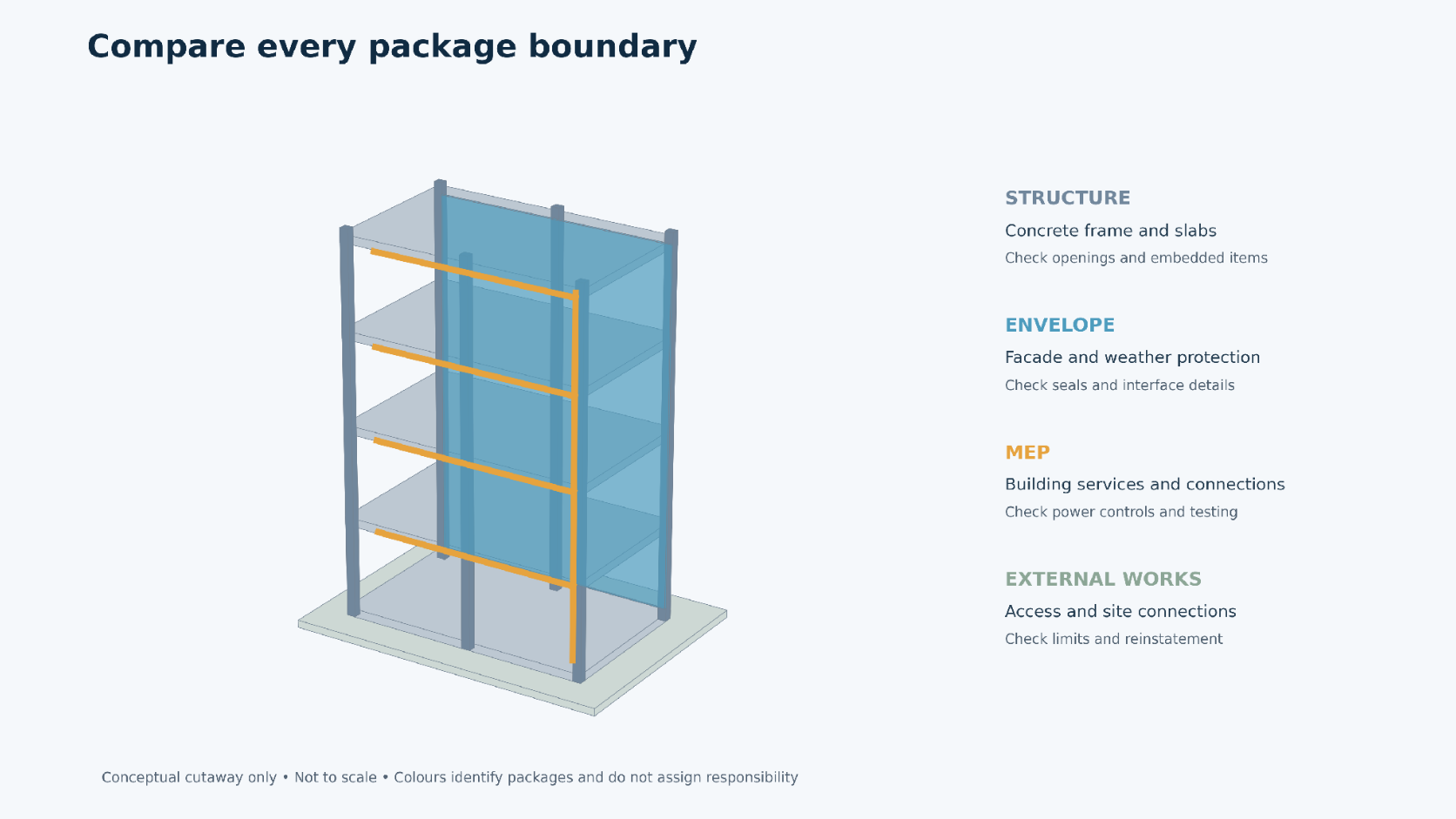
Build a construction scope comparison around work packages rather than broad promises such as “complete construction”. Start with civil and structural work, then check the envelope, finishes, building services and external works. Confirm whether enabling activities, temporary facilities and protection of existing property are included.
Mechanical, electrical and plumbing systems cross several package boundaries. For example, supplying an air-conditioning unit does not establish responsibility for its electrical feed, controls, drain, supports or commissioning. Ask who provides each interface and where its price appears. Refer to the MEP services scope when preparing these questions.
Use a contractor proposal comparison checklist like the matrix below. Replace the illustrative entries with actual proposal references. Record “unclear” wherever a submission does not establish inclusion; silence is not evidence that work has been priced.
| Requirement | Contractor A | Contractor B | Evidence or action |
|---|---|---|---|
| Drawing basis | Revision 03 | Revision 02 | Reconcile the issue register |
| External drainage | Included | Excluded | Obtain defined scope and price |
| MEP interfaces | Partly described | Schedule attached | Confirm remaining connections |
| Testing and records | Unclear | Listed | Request deliverable schedule |
| Site facilities | Allowance | Included | Confirm allowance coverage |
Check demolition, disposal, excavation assumptions, utility connections and reinstatement where relevant. For owner-supplied equipment, agree unloading, storage, installation, damage responsibility and warranty interfaces. Show separately any work assigned to a utility, landlord or specialist. This avoids treating an owner’s future purchase as a saving in the contractor’s offer.
A bill of quantities review checks descriptions, units, quantities, rates and extensions against the enquiry documents. Ask whether the quoted amount is a lump sum, a measured contract or a preliminary estimate. The agreed contract determines how quantity changes affect payment; the quotation heading alone is insufficient.
Look for omitted lines, duplicated items and unusually uneven rates. Request explanations rather than assuming an error or accepting a low rate at face value. A rate may depend on a stated quantity, access condition or material choice that differs from your requirements.
List construction bid exclusions in one place. Distinguish excluded work from a provisional allowance: an allowance is a budget placeholder, while an exclusion may require a separate appointment or purchase. Ask how allowances will be instructed, valued and reconciled, including any associated attendance or overhead charges.
To compare construction contractor proposals fairly, keep confirmed amounts separate from unresolved exposure. Check the currency, quotation validity, stated tax treatment, delivery charges and any adjustment provisions. Have the relevant adviser confirm tax treatment; do not assume a single rate applies to every item or project location.
Request a dated written response for ambiguous wording such as “standard quality” or “as required”. Record an actual specification or agreed acceptance basis. If a proposed alternative changes performance, maintenance or lead time, assess it separately from the compliant base offer.

Ask what starts the construction period: contract signature, possession of the site, advance payment, approved drawings or another event. Two offers stating six months may assume very different starting conditions. Record access restrictions, working hours and any occupied areas that affect productivity.
Request a programme showing design decisions, submittals, procurement, construction, testing and completion milestones. Check the connection between long-lead purchases and required installation dates. Ask which owner decisions are needed, who supplies them and how late information will be managed.
Test the resource assumptions behind the dates. Identify the proposed site manager, key subcontractors, critical equipment and competing commitments. A shorter duration needs a credible sequence and resources. For site establishment, compare the mobilisation and early works requirements against access, temporary services and storage arrangements.
Consider location-specific conditions such as delivery access, seasonal weather exposure and utility availability using actual site information. Avoid nationwide assumptions. Ask for the contractor’s proposed management approach and the contractual treatment of disruption rather than accepting an unconditional completion promise.
For an occupied commercial building, also ask how the programme separates tenant operations from construction. Identify shutdown windows, protection measures, access arrangements and the person approving disruption. A programme that assumes unrestricted access needs clarification if your building must remain in use.
Compare contractor payment terms against the work and evidence you will receive. Record the advance, payment milestones, valuation method, payment period and any agreed retention or security arrangements. Request a cash-flow forecast so your finance team can understand when funds are required.
A milestone labelled “materials ordered” needs definition. Ask which materials, what supporting documents are required and how ownership, storage and delivery will be addressed. Early payment exposure can differ substantially even when two proposed contract totals are identical.
Clarify who may authorise changes and how the contractor must submit their price and programme effects. Agree the information needed for review before work proceeds, subject to the contract’s instructions and emergency provisions. Keep a written variation register rather than relying on site conversations.
Read price-adjustment wording carefully. Identify whether prices are fixed, adjustable under a stated mechanism or subject to supplier reconfirmation. Record the trigger and supporting evidence. Ask a qualified contract adviser to review allocation of risk, insurance, security, delays and termination before signing; this comparison guide cannot establish suitable contract terms.
For construction contractor proposals in Pakistan, check the bidding legal entity and the proposed delivery team. Request comparable project references and ask what the contractor actually delivered, under which role and with which key personnel. Seek permission to speak with previous clients about scope, coordination and completion evidence.
Where PEC registration is required, check the firm through PEC’s constructor/operator verification route and confirm the relevant category, specialisation and current status. Match the record to the entity submitting the proposal. A certificate copy alone does not establish continuing validity or suitability for your particular work.
Ask for project-specific quality and safety arrangements, inspection responsibilities and specialist competence evidence. Record who will check concealed work and witness tests. Evaluate the people assigned to this project, including their availability, rather than relying only on a corporate presentation.
Suppose two contractors submit offers for the same small commercial project. The following figures are hypothetical Pakistani rupees (PKR), created only to demonstrate the method. They are not market rates, a cost estimate or a formal tender evaluation formula. Assume both offers use the same confirmed tax basis.
| Comparison item | Contractor A | Contractor B |
|---|---|---|
| Quoted total | PKR 20,000,000 | PKR 21,000,000 |
| External drainage | Excluded; confirmed addition PKR 800,000 | Included |
| Specified testing | Excluded; confirmed addition PKR 300,000 | Included |
| Subtotal including confirmed additions | PKR 21,100,000 | PKR 21,000,000 |
| Utility connection fee | Unresolved | Unresolved |
The apparent PKR 1,000,000 saving becomes a PKR 100,000 difference in the opposite direction after confirmed additions. Neither subtotal is the final project budget because the utility fee remains unresolved. Do not insert zero or an invented allowance to make the table look complete.
This is how to compare construction contractor proposals without hiding uncertainty. The owner must still examine programme, payment exposure, capability and compliance. For a formal procurement, apply the established evaluation method and permitted clarification process; do not alter tender rules to reproduce this illustration.
Retain the original offers alongside the comparison and clarification responses. This gives your reviewer a clear history of which amounts came from bidders, which additions were confirmed and which questions still prevent a reliable decision.
Keep one clarification record linked to the comparison. Assign each issue an owner and response date, then cite the final document that closes it. Obtain revised written offers where needed and follow the applicable procurement process consistently.
| Question | Responsible person | Due date | Closure evidence |
|---|---|---|---|
| Which drawing revision is priced? | Bidder commercial lead | Set date | Revised offer reference |
| Who supplies controls cabling? | Bidder MEP lead | Set date | Agreed interface schedule |
| What completes handover? | Owner and bidder leads | Set date | Accepted deliverable list |
Define contractor handover requirements before selection, including applicable test records, as-built drawings, operating manuals, warranties, training and outstanding-defect arrangements. Name the person who accepts each deliverable. Physical completion and readiness to operate should have clear acceptance evidence.
Record your recommendation with its reasons and remaining conditions. When you compare construction contractor proposals, the strongest decision is one another reviewer can trace to documents. Discuss your scope, location and proposal requirements through Podium’s construction services page, and confirm the appropriate Pakistan contact route and project availability.
Yes, after establishing the same scope and quantity assumptions. Record how each pricing method treats measurement and changes. Ask your quantity surveyor to identify remaining exposure before presenting the offers as financially comparable options.
Ask for written clarification through the permitted procurement process. A blank may mean included elsewhere, excluded or omitted; do not decide which yourself. Record the confirmed interpretation and its document reference before completing your comparison.
Keep the compliant base offer identifiable and assess alternatives separately. Record the change in scope, performance, maintenance and delivery implications. Apply the enquiry rules consistently so an alternative does not conceal a missing base requirement.
Request written confirmation of an extended validity period and whether price, availability or programme assumptions change. Update your comparison with the revised offer reference. Follow the applicable procurement procedure before relying on an expired submission.
Registration is one eligibility check, not a complete capability assessment. Verify applicable details and current status, then review relevant experience, assigned personnel, resources and references against your project requirements before making a documented selection decision.